
Morocco’s elections are unlikely to change an entrenched political order. Though the Islamist PJD may recover from its previous defeat, electoral engineering and elite competition could keep it from regaining power in a major way.
Morocco’s 23 September legislative elections seem to consolidate the 2021 status quo rather than being a real contest between parties. The electoral rules – electoral quotient, constituency design and control of voter registration – that produced the 2021 outcome are reproduced with some cosmetic and procedural changes. Ahead of the vote, the main competition is not between the Parti de la Justice et du Développement (PJD) and a party close to the palace (also called administrative parties in the Moroccan context) as was the case for almost two decades, but between two administrative parties – the Rassemblement Nationale des Independents (RNI) and Parti Authenticité et Modernité (PAM) – who entered a war of attrition that may benefit the PJD.
PJD which seems to be regaining visibility and self-confidence after its historic 2021 defeat, when it collapsed from 125 seats (won in 2016) to just 13. It may increase its seats count this year, but this does not amount to a return to relevance or central status.
Electoral context
The 2026 election is being held against a contentious social context, characterised by declining public trust in the government’s ability to respond to social demands and recurring corruption controversies. In October 2025, Gen Z youth protests erupted across the country, calling for economic improvement and social justice. In response, the government promised to improve youth participation by allowing independent lists for candidates under 35, providing them with financial support for their campaigns and directing parties to grant nominations for young candidates. Nearly a year later, those promises to have been only partially honoured.
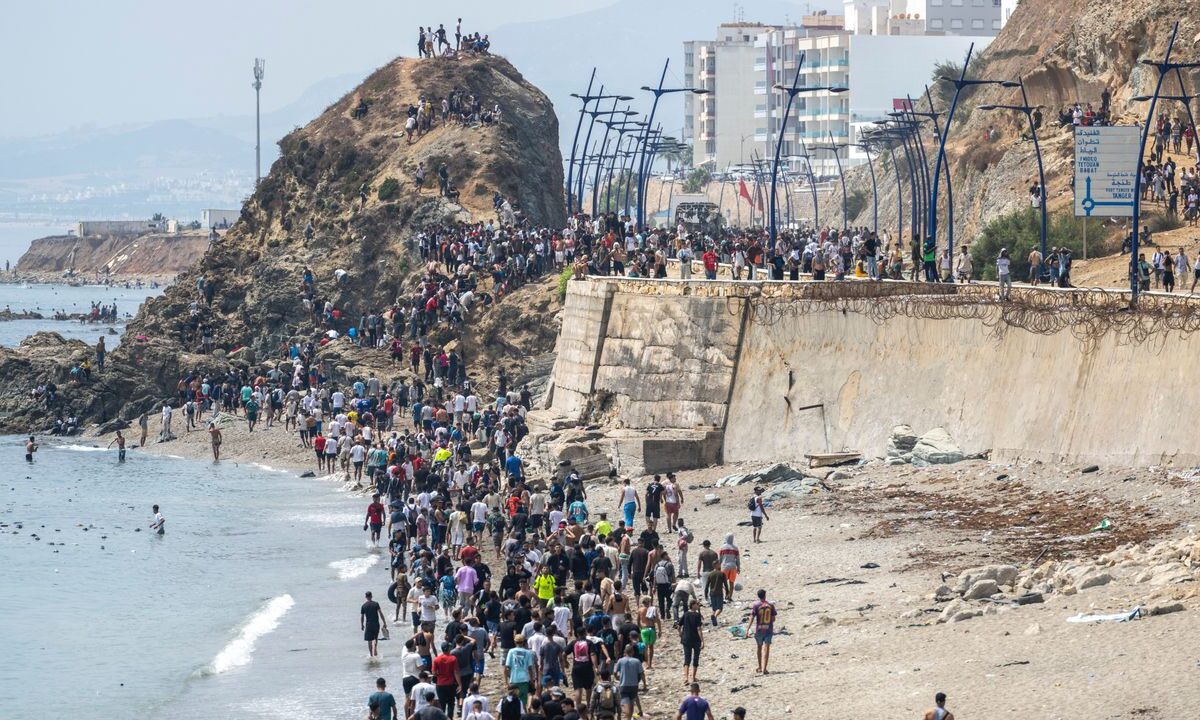
Less than a year after the Gen Z protests, in late July and early August this year, Morocco saw a mass informal crossing of its citizens into Ceuta. This was the largest single such movement since 2021, with an estimated 50,000-80,000 people attempting the journey on foot or swimming: around 140 people lost their lives and many families are still searching for their missing relatives. Rabat’s management of this crisis drew sharp criticism after Spanish media reported that Moroccan Prime Minister Aziz Akhannouch went on holiday in Mallorca in a private jet while the crisis was unfolding. While Spanish Prime Minister Pedro Sánchez visited Ceuta and was frontline in communicating with the public, Moroccan government officials went silent for several days before a Ministry of Interior bureaucrat came out with a meagre statement.
Against this backdrop, little public engagement has been seen these weeks preceding the elections: no serious public debate, little attention being paid and even scarcer pre-campaign rallies compared to previous cycles.
The more it changes, the more it stays the same
The rules governing this election are structurally similar to those that produced the 2021 outcome, with only limited procedural changes. This year’s reform of electoral laws eased requirements for young independent candidates and introduced digital candidacy submissions, while keeping the core architecture – the electoral quotient, voter registration and constituency design – untouched. The most important mechanism of electoral engineering remains the electoral quotient, the basis on which the seats are allocated. Because it is grounded in the number of registered voters, not the votes cast, it is, in practice, impossible for any party to win more than one seat per district, which creates a structural barrier for any party to reach more than 100 seats and rewards small and medium parties. The constituency design, i.e., the electoral map, is the second instrument. In principle, seats should be allocated in proportion to each district population, but in practice this has been undermined by a rule guaranteeing a minimum of two seats per province regardless of the size of the population and a district map based on outdated census data. The result is an imbalance between districts, with some large urban districts holding far more registered voters per seat than smaller, especially rural ones.
Voter registration is the third tool. The number of registered voters fell from roughly 18 million in 2021 to 15.8 million in 2026 out of around 26 million eligible citizens. The Ministry of Interior attributes the reduction to routine list cleaning, including removing deceased voters, changes of address. But this argument does not hold: back in 2021, senior PJD leaders were erased from the electoral list by an administrative decision, with party’s Abdelali Hamieddine labelling this a “political scandal”.
Taken together, these are the main tools the regime uses to engineer elections and create a ceiling on any single party winning a majority in parliament, which ultimately remains fragmented and weak.
This election is also dominated by local notables. These traditional local networks built on economic and social capital are capable of winning elections: they hold no political allegiance and shift towards whichever party the state implicitly favours at each successive cycle. In 2021, it was RNI and in 2026, PAM seems to be the chosen one. In the final weeks preceding the election, several MPs and local notables have switched parties, mainly migrating towards PAM. This shift has coincided with the ascendance of Faouzi Lekjaa’s de facto leadership of the party. His role as president of Morocco’s football federation grants him an extensive network and public visibility, which have attracted traditional networks of notables.
The fake RNI-PAM rivalry
What makes this election distinct is that the main competition is not between the PJD and one of the administrative parties, but between two administrative parties: RNI and PAM. Both were founded by people close to the royal circle and are currently part of the government. RNI is at the helm of government and PAM manages important portfolios, including the budget ministry led by Lekjaa.
In the weeks preceding the vote, RNI has attacked PAM for stealing its members. Ironically, in February 2026, Akhannouch handed the leadership of RNI to Mohamed Chouki, who himself switched from the PAM to RNI. When RNI accused PAM of stealing its MPsand members, the latter responded in a statement on 26 August that they “will not accepts lessons from a party that previously nominated 17 MPs from 5 parties, including from PAM”. This dynamic of mutual attrition, where each side is blaming the other of the same practice, captures how much this contest is about elite capture rather than programmatic difference – which may indirectly benefit the PJD.
A possible PJD comeback?
The race’s top two spots seem to be out of reach for the PJD. The party lost most of its power and seats in the 2021 elections, falling from 125 in 2016 to 13 in 2021. Some estimates show that the result could have been even worse if the old electoral system has still been in place, which signifies that the electoral quotient reform was not the main factor in the PJD’s electoral debacle. While this does not mean that electoral engineering is irrelevant, the 2021 can mainly be attributed to pressure from PJD rivals.
Following its historic win in 2016, the PJD’s rivals pushed it to make painful compromises. After the 2016 “blockage”, King Mohammed VI dismissed Prime Minister Abdelilah Benkirane and replaced him with Saâdeddine El Othmani, a more conciliatory personality who, as well as signing the normalisation of relations with Israel in 2020, oversaw the shift to science education to French and the legalisation of medical cannabis. What the regime did, substantially, was co-opt the PJD leadership, forcing them to accept painful concessions, which consequently led the party to lose credibility in the eyes of its own rank and file. PJD members and Mouvement de l’Unicité et de Réforme (MUR) sympathisers boycotted the 2021 election campaign, and many prior PJD supporters did not vote for the party. Since Benkirane assumed the leadership in October 2021, he devised a new political strategy to regain the party’s self-confidence and repair its machinery, with a focus on three main issues: identity politics, Palestine and Gaza, and anti-corruption – with the PJD’s parliamentary bloc exposing corruption cases and criticize the record of Akhannouch government.
Morocco has no opinion polling on voter intentions, making quantitative projections difficult. It seems likely, however, that the PJD will win more than its current 13 seats but far fewer than the 125 it gained in 2016. My own estimate is that the party could win around 40-50 seats – a subjective judgement based on qualitative observations of the PJD’s campaign performance and the state of its party machinery. This projected recovery rests primarily on Benkirane’s new strategy and remobilisation of the party’s base since 2021. It also builds indirectly on the RNI-PAM rivalry, as it marks out the PJD as a serious and independent party that relies on its own base and members rather than on elites that switch allegiance every electoral cycle. In all cases, a potential PJD recovery would not put it in a position to lead the government but would be enough to make it a middle force capable of navigating the rivalry between the RNI and PAM.
An important factor in the PJD’s position will be the turnout and how the party will fare in its urban strongholds, where is has historically performed better than in rural areas. For instance, in 2015 local elections the PJD ranked first in all major cities, such as Casablanca, Rabat, Tangier and Fes. By contrast, administrative parties such as the PAM and RNI rely heavily on rural and small-town voters due to the clientelist networks that local notables mobilise during electoral periods. According to the current voter registration list, 45% of voters are in rural and 55% in urban districts, while urban dwellers represent around 63% of Morocco’s population as per the 2024 general census. Historically, turnout in urban areas is much lower than in rural ones, a factor that could limit a PJD rebound.
A PJD-PAM alliance?
A PJD-PAM pact is difficult to conceive given their historical animosity. Yet Benkirane’s relationship with Lekjaa has fluctuated. Following the latter’s formally joining PAM in mid-2026, Benkirane launched a sharp attack on the party and its de facto leader but has more recently shifted to primarily targeting Akhannouch and the RNI. Regardless, Benkirane’s attacks on Lekjaa are much less aggressive than those of previous PAM leaders such as Ilyas El Omari. A PJD-PAM alliance would be a significant event in Moroccan politics but contingent on three conditions: PAM leading the elections, the PJD faring well enough (40-50 seats) to negotiate from a position of strength, and more importantly, both parties agreeing to form a government.
The PJD may be seeking a role in the next government that it cannot secure alone and the PAM, for its part, may want to end the polarisation with the PJD and claim broader legitimacy by partnering with it. This scenario echoes Morocco’s 1999 succession context, where opposition parties were brought into government to project stability during a political transition. A similar logic could favour a broader coalition that includes the PJD and PAM as the country approaches both the 2030 World Cup and its next royal transition. This remains just one potential scenario, dependent on the three conditions above. Whatever the case, the PJD may at best be a junior partner in the new government.
Mohammed Masbah
Mohammed Masbah is the Founder and President of the Moroccan Institute for Policy Analysis (MIPA). He is a political sociologist whose work centers on public policy, democratization and political Islam, with a focus on North Africa. Dr Masbah is an Associate Fellow at Chatham House in London and adjunct professor at Mohammed V University. He was previously a non-resident scholar at the Carnegie Middle East Center, and a fellow at the German Institute for International and Security Affairs (Stiftung Wissenschaft und Politik, SWP) in Berlin. Dr Masbah obtained his PhD in Sociology from Mohammad V University in Rabat. His dissertation examined the processes of radicalization and deradicalization of Moroccan Salafis since Casablanca bombings in 2003. His recent publications include: Moroccan Jihadists: Local and Global Dimensions, Al Jazeera Centre for Studies, 2021. Trust in Institutions Index 2020, Moroccan Institute for Policy Analysis, 2020. Rise and Endurance: Moderate Islamists and Electoral Politics in the Aftermath of the ‘Moroccan Spring’” in Islamists and the Politics of the Arab Uprisings: Governance, Pluralisation and Contention (Edinburgh University Press, 2018) Contact the author: m.masbah@mipa.institute